Caught You Glancing: Meet Europe’s ‘Accidental Audience’ of Smartphone Screens
April 16, 2026
Europeans may think of their smartphones as private, but in public, they often come with an unexpected audience. New research[1] from Samsung Electronics highlights a clear mismatch: while 48% of people believe their phone use in public is private, 52% say it is easy to see someone else’s screen.
This awareness gap is giving rise to a new reality: the “accidental audience”.
Who are the “accidental audience”?
The “accidental audience” is made up of people who look at someone else’s phone screen when out in public. It is not planned, and sometimes not even intentional. Just something that happens when out and about.
The research shows:
- 56% of Europeans have accidentally looked at a stranger’s phone
- 24% admit curiosity has occasionally led them to look
- 49% say they have felt someone else glance at their own screen
How is the accidental audience viewing your phone screen?
These moments are most likely to happen in shared, close-contact environments. Public transport is the most common setting, according to 57% of respondents.
Other everyday scenarios include:
- Waiting in queues (35%)
- Sitting in cafés, bars or restaurants (13%)
In these settings, glances are part of everyday life, and nearby phone screens often fall into view.
What are people actually seeing?
Often, it is more personal than expected. One in three Europeans (33%) says they have seen private content on a stranger’s phone screen.
The most commonly spotted content includes:
- Personal photos or camera roll (38%)
- Video calls showing people’s faces or voices (33%)
- Private messages (29%)
- Social media notifications (27%)
- Online shopping (17%)
- Dating app content (12%)
- Banking or financial details (11%)
For many, these are brief, passing moments – but 27% say they have seen something they felt they were not meant to see, highlighting how easily private content can become public.
How are people protecting their phone screens in public?
As awareness of the “accidental audience” grows, many people are making small changes to how they use their phones in public. The Samsung Electronics research shows that 38% of Europeans have delayed or avoided certain actions on their device when in shared spaces.
Common adjustments include:
- Doing online banking at a different time (62%)
- Holding off entering passcodes (49%)
- Saving personal messages for later (43%)
In the moment:
- 42% stop using their phone
- 28% continue as normal
- 27% of the “accidental audience” look away
- 7% of the “accidental audience” keep looking discreetly
Only 10% would address it directly, suggesting most people accept the people seeing their screen as part of modern life and quietly adapt.
Can smartphones have a built-in privacy display?
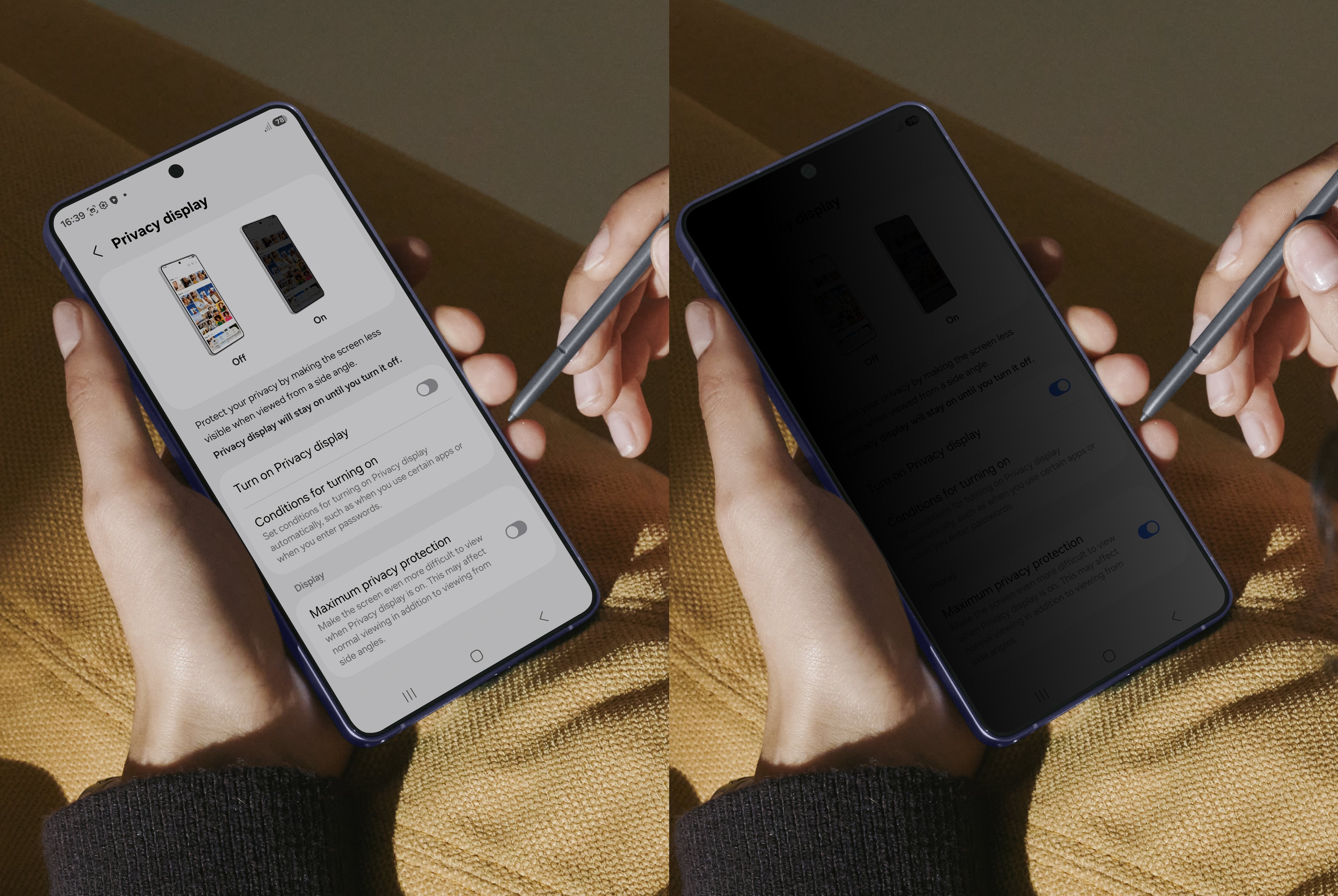
As this behaviour becomes more common, smartphone design is evolving to match real-world use. The Samsung Galaxy S26 Ultra introduces a Privacy Display[2] that reduces visibility from side angles and limits what others can see[3].
Helping to shift power back towards the user, giving people the opportunity to exercise more control over what is visible and when.
A new normal for smartphone use
In a world where smartphones are used everywhere, small moments of visibility are inevitable.
What is changing is awareness. Europeans are becoming more conscious of who might be watching and adjusting how they use their devices accordingly.
Because these days, when you use your phone in public, you might not be the only one seeing it.
[1] Survey of 11,000 smartphone users (1,000 in each market) across UK, France, Germany, Spain, Italy, Sweden, Denmark, Finland, Norway, the Netherlands and Belgium conducted by Censuswide.
[2] Requires manual activation in settings to function. Privacy Display feature is not AI-powered.
[3] When activated, some information may still be visible to others depending on the viewing environment, such as the angle or brightness. Caution is advised when exposing sensitive information.


