

[Editorial] Leading the Way in Enterprise Mobile Security: Samsung’s Zero Trust Strategy
By Dr. Jerry Park, EVP & Head of Global Mobile B2B Team, Mobile eXperience Business at Samsung Electronics
1/27/2026



Today’s world is one of unprecedented innovation and rapidly evolving technology. It’s an era of endless possibilities, coupled with a new set of risks for security and privacy. At Samsung Electronics, we recognize that as we enter these uncharted territories, we must be prepared for potential threats that may arise. That’s why we stay deeply attuned to the ever-changing security landscape and champion a dynamic approach to enterprise security.
The cybersecurity threats of today affect everyone, from consumers to businesses. Enterprise device fleets must be resilient against attacks of all kinds — from suspicious URLs, insider employee threats and malware, to emerging risks associated with AI usage in the workplace, including prompt injection and sensitive data leaks. As a growing number of employees across industries — from corporate offices to the frontlines — use devices to access enterprise networks and resources, these threats not only present significant security risks but may also lead to a substantial financial toll on businesses.
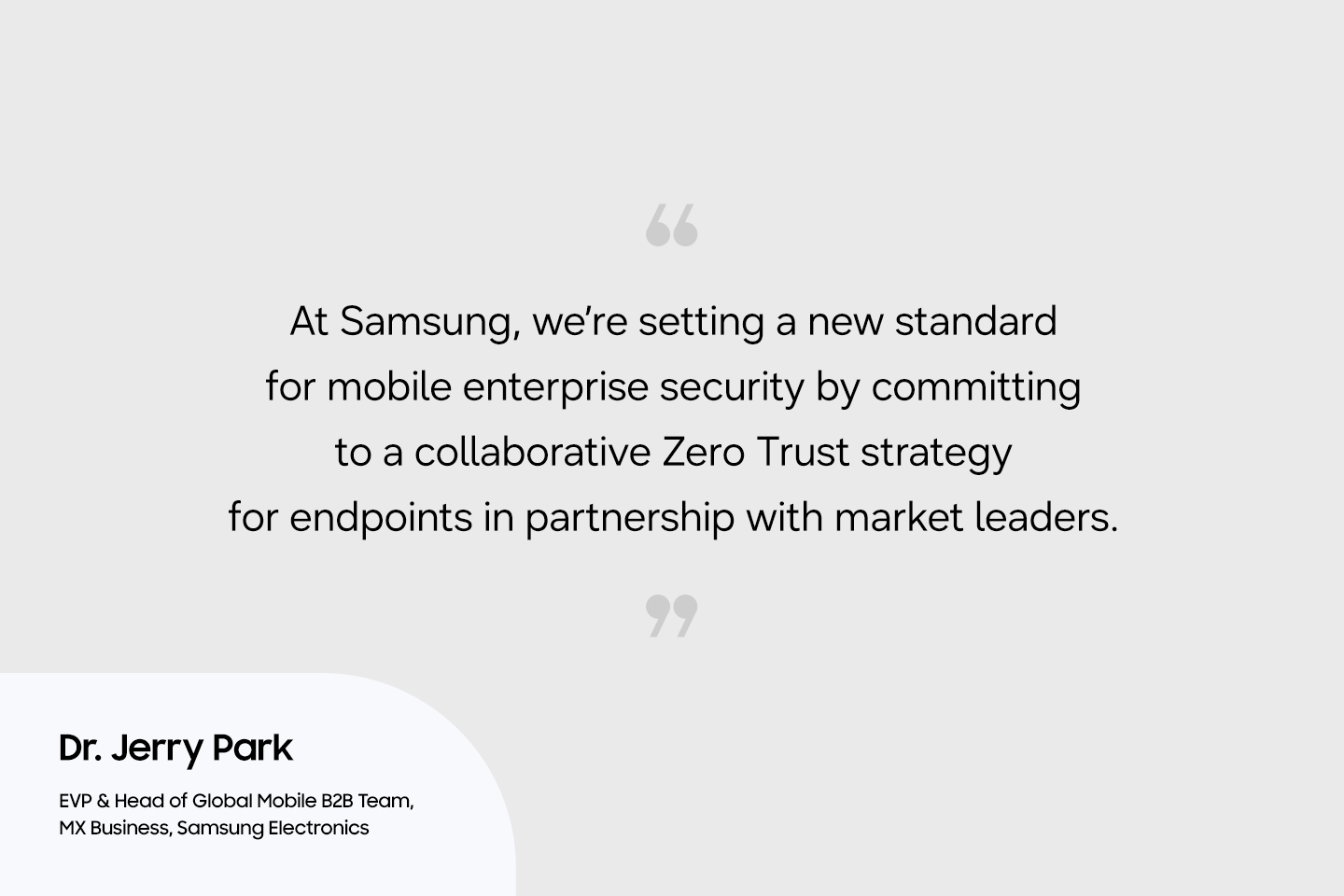
Enterprise security incidents can arise across operations. However, the International Data Corporation (IDC)1 found that an overwhelming 70 percent of successful breaches originate from endpoints — the devices that connect to networks like phones, laptops and tablets. Unfortunately, in today’s security operations landscape, IT administrators have much less visibility into mobile devices compared to PCs and servers. With mobile devices now being the most common method of employee network access, this has to change. A systematic, comprehensive approach is critical to ensuring seamless mobile capabilities and uncompromising protection. At Samsung, we’re setting a new standard for mobile enterprise security by committing to a collaborative Zero Trust strategy for endpoints in partnership with market leaders.
Core Principles for Zero Trust Endpoint Security
Samsung’s legacy of innovation is built upon our deep understanding of users. We’re constantly listening to feedback from consumers and businesses, anticipating the evolution of mobile technology. This is what enables us to pioneer industry-first solutions for consumers and businesses alike. As the Head of the Global Mobile B2B Team, I’m especially proud of how we’ve led the way in critical areas that deliver value to enterprises across the board. From advancing hardware-backed device attestation and threat detection to fully embracing the security principles of Zero Trust, we are constantly striving to provide our customers with mobile devices and solutions that exceed their security requirements.
Zero Trust is a security framework that replaces implicit trust with explicit trust by continuously assessing security posture, risk and trust levels based on context. The current security solutions market is dominated by network-centric Zero Trust solutions that focus on securing access at the network edge. Unfortunately, this approach by itself neglects a critical blind spot: the endpoint. Endpoints have the largest attack surface and are the most challenging IT assets to protect against cyberattacks. In most cases, they are the most vulnerable points in an organization’s IT ecosystem.