Team Galaxy Answers Foldable Questions ②: There’s So Much More to the Fold
01-10-2026
For the second part of this series, Team Galaxy explores what it takes to make a foldable work for everyday life.
A foldable can offer a new way to experience a smartphone, but the real test begins when it becomes your everyday device.
Can it take the kind of photos you expect from a premium smartphone? Will your favorite apps work naturally on a different screen shape? Is a foldable still practical to carry around? And with different form factors now available, how do you know which one fits you?
In the second part of this series, Team Galaxy takes on these questions from a more everyday perspective.
#1 “Can a foldable really have a great camera?”
Foldables have traditionally been associated with their displays and form factors. But as the category matures, consumers increasingly expect the rest of the experience to match the premium price.
Samsung’s answer is to bring flagship-level mobile photography into its foldable portfolio.
The Galaxy Z Fold8 Ultra features a 200MP camera, giving users the high-resolution imaging capabilities they expect from a premium Galaxy device — without having to choose between an advanced camera and a foldable form factor.
There’s no need to compromise, as Vivian Liu shares.
#2 “A new screen shape means new app problems, right?”
Changing the physical shape of a smartphone naturally raises questions about the software experience.
What happens to the apps I already use? Will everything work properly? And what about moving all my information from my existing phone?
Samsung has spent years developing the software experience around foldable displays, while working with popular apps to make the transition into the new form factor feel natural. So when you watch your favorite content, there is no letterboxing – no black bars, as Kittie Yiyi points out.
And for consumers switching from another smartphone platform, Smart Switch1 helps make the move from iOS to a new Galaxy device easier by transferring important data and content.
#3 “Won’t a foldable be bulky and heavy?”
Early foldables had to balance ambitious new engineering with the practical realities of carrying a smartphone every day. That has changed significantly as the technology has matured.
In short, powerful phones like the Galaxy Z Fold8 Ultra do not have to be bulky. It’s a premium, usable form factor that only weighs 215g.
The Galaxy Z Fold8, Samsung’s thinnest and lightest Fold yet2 at only 201g, further demonstrates how eight years of engineering have gone into making the form factor more portable and practical.
And both of these powerful phones are lighter and thinner than Alex HKF’s everyday notebook. The goal is no longer simply to make a phone that folds. It’s to make a foldable that feels natural to carry.
#4 “Should I just upgrade to the next conventional flagship instead?”
Not every consumer needs a foldable. But for those considering a new smartphone, the question is increasingly about what kind of experience they want from their next device. The choice isn’t simply between one phone and another. It’s between different ways of using a smartphone, and often, it also comes back to what conventional bar or slab phones offer.
Ori shows us how the Galaxy S26 Ultra demonstrates that Samsung’s innovation isn’t limited to foldables – from its 200MP camera capabilities and Horizontal Lock experience to Privacy Display and Galaxy AI. It offers a different approach to the conventional smartphone, particularly for consumers who value intelligent, private and versatile mobile experiences.
#5 “A new foldable shape sounds interesting. But how do I know which one is right for me?”
This may ultimately be the biggest change in the category. There isn’t one definition of what a foldable should look like anymore. Samsung’s latest Galaxy Z lineup offers three distinct approaches to the form factor, designed around different needs and lifestyles.
The trendy Galaxy Z Fold8 is built around a more immersive, wider-screen experience. Abdul Qawiy Aro puts it simply: “The Galaxy Z Fold8’s all-new design and larger display deliver a truly immersive viewing experience.”
The powerful Galaxy Z Fold8 Ultra takes the large-screen concept further for consumers who want maximum productivity and capability. “Safe to say, productivity just got an upgrade,” says Daryl Tan.
And the expressive Galaxy Z Flip8 brings the foldable experience into a compact, pocket-friendly form factor for everyday convenience.
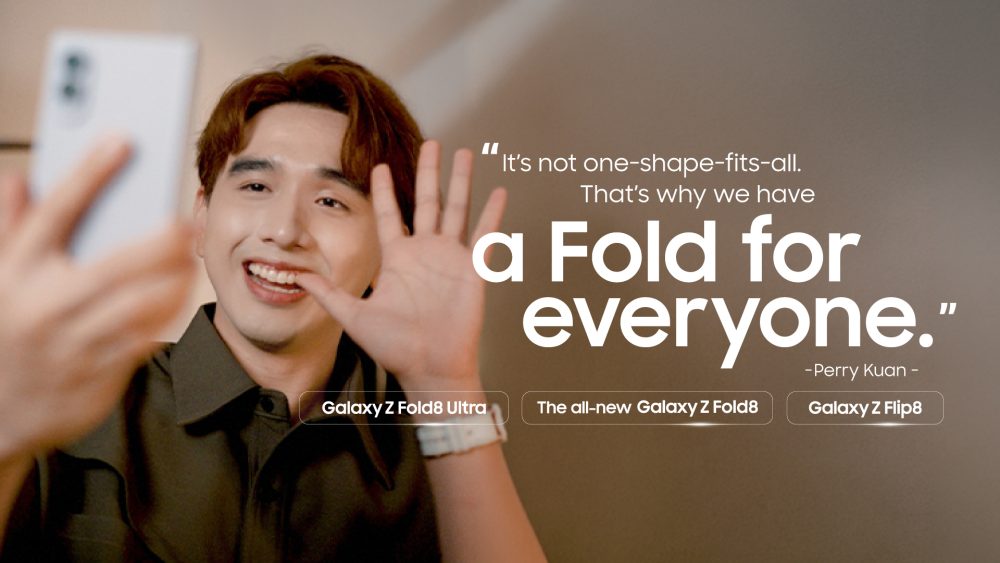
Watch as Perry Kuan showcases three shapes. Three experiences. Different reasons to fold.
Eight years of progress changes the questions
The evolution of foldables can ultimately be measured by the questions consumers are asking.
Early on, it was simply: “Can a smartphone really fold?”
Then came: “Will it last?”
Today, the questions are more sophisticated: “Which form factor suits me? What can I do with the extra screen? How much more productive can I be? How seamlessly does it fit into my life?”
That evolution matters. Because it shows that foldables have moved beyond being an experiment in smartphone design. They have become another way of thinking about what a smartphone can be. As more of the industry embraces the form factor and brings foldables to a wider audience, Samsung users already have years of experience with that future.
- Transferable data may vary depending on the device OS (Android or iOS), OS version and connection method. Data transfer from an iOS device to a Galaxy device using the upgraded method is available on devices running Android 17 or later and iOS 26.6 or later in regions outside mainland China. ↩︎
- Compared to previous Galaxy Z models. ↩︎


