The Hidden Journey of Air Inside Samsung’s Most Powerful Cordless Stick Vacuum from Samsung


Samsung has recently launched the Bespoke AI Jet Ultra in the Southeast Asia market. Equipped with an AI feature, a filtration system boasting a 99.999% filtration efficiency,[1] and an All-in-one Clean Station™ that takes care of cleaning from start to finish, this model offers diverse functionalities.
Among its many descriptors, the most important one is undoubtedly this — Samsung’s most powerful cordless stick vacuum cleaner.[2] The Bespoke AI Jet Ultra, capable of delivering up to 400W of suction power,[3] is revolutionising the cleaning experience for consumers in their daily lives.
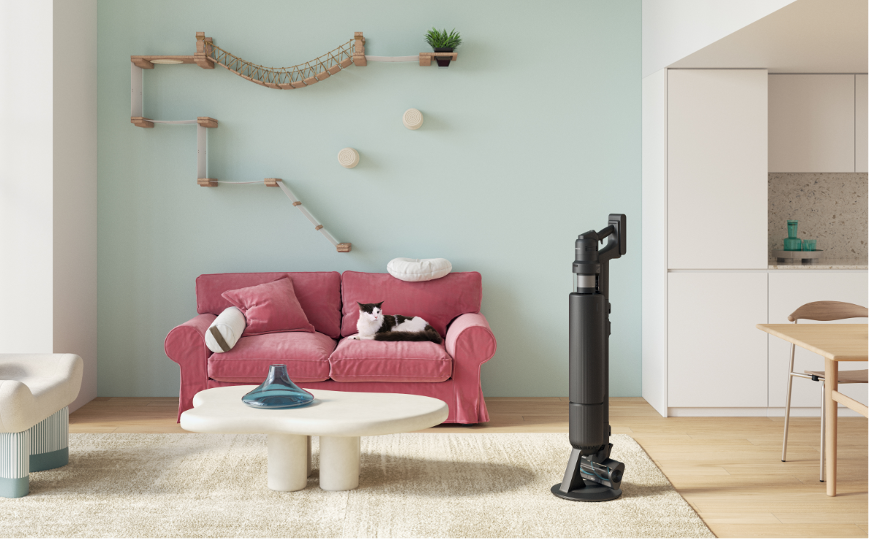
What really makes it all happen is a process you can’t see: Air moving through the vacuum’s complex internal system, carrying everything from fine dust to stubborn debris. This invisible air path determines how strong, stable, and effective a vacuum’s suction truly is.
Samsung spent six years refining that journey. Every twist and turn, from intake to motor, was reengineered to allow air to move without interruption.
The multi-cyclone system: Your personal spin expert
When air enters the vacuum, it carries everything from pet hair to fine dust[4] particles. It travels through a long internal air path and encounters the multi-cyclone system where it spins at high speed. The centrifugal force flings dust outward, separating particles so clean air can move forward – efficient, but intense.
However, the spinning also creates resistance that can weaken suction. To address this, Samsung introduced a multi-cyclone structure with 12 cyclones and 33 air inlets. With more entry points and evenly distributed airflow, resistance is reduced, allowing efficient dust separation while maintaining strong, stable suction.
The motor: Through the eye of the storm
After the cyclone system, the air reaches the motor, spinning at up to 148,000 revolutions per minute. Inside, the impeller, — shaped like jet engine blades—spins air outward to create a vacuum. If air flows the wrong way back in, it disrupts suction. To prevent this, Samsung upgraded the diffuser from single-row to a two-row structure,[5] giving air more exit routes to maintain vacuum pressure and suction consistency. This helps maintain vacuum pressure and consistent suction by allowing air to escape more smoothly.
The Real-Life Impact of 400W Suction Power
What practical difference does the 400W suction power actually make in real life? Recently, Samsung released a video showcasing experiments conducted in various environments to demonstrate just that.
In one test, a ball is placed on one end of a tube. When the vacuum runs on Max, the ball slowly rolls forward but eventually stops midway. However, in Jet mode, it zips straight to the inlet and sticks.
In another, a tube pulls water from a water tank. Max mode lifts the water halfway, while Jet mode fills at such a rapid speed that it overflows the tank. This power is just one part of what makes the overall product stand out.
Driven by the details
From the shape of a cyclone to the structure of a diffuser blade, every element of the Bespoke AI Jet Ultra was optimised with one goal: let air do its job without obstruction. With this device, Samsung didn’t just create a vacuum. It added details to the path air takes, and in doing so, pushed suction performance to a whole new level.
To learn more about the Bespoke AI Jet Ultra, visit Samsung.com.
[1] Based on internal test in accordance with the IEC 62885-2 Cl. 5.11 standard, using Jet Mode. Results may vary depending on actual usage.
[2] Based on testing by SLG Prüf- und Zertifizierungs GmbH, in accordance with the IEC 62885-4 Cl.5.8 standard, using a handheld type vacuum cleaner (with no brush) in Jet mode. The results were compared to cordless stick vacuum models available on the market with a stated suction power within 30% of the actual suction power of the Samsung model tested by SLG. Based on sales data between January 2024 and December 2024 as compiled by an independent market research institute.
[3] Based on testing by SLG Prüf- und Zertifizierungs GmbH, in accordance with the IEC 62885-4 Cl.5.8 standard. Measured at the inlet of the non-motorised tool when the dustbin is empty, using Jet Mode and a large capacity battery that is fully charged. Lasts up to 1 min.
[4] Refers to dust particles in the size range of 0.5 to 4.2µm.
[5] Compared to previous Samsung Bespoke Jet series
Products > Home Appliances
For any issues related to customer service, please go to samsung.com/support for assistance.
For media inquiries, please contact samsungsg@infom.asia.


