[World Sleep Day] How Samsung Is Tackling Sleep Apnea to Energize Your Days
13-03-2026
Millions worldwide suffer from sleep apnea, but 80% of sufferers[1] don’t even know they have it. This serious condition causes people to experience pauses in breathing while asleep — potentially disrupting oxygen supply, lowering sleep quality and leading to health complications including hypertension and stroke. Despite these risks, the disorder largely goes unnoticed because getting a diagnosis usually requires time-consuming and costly in-lab sleep studies.
To mark World Sleep Day 2026, a global study of Samsung Health users[2] is shedding new light on the true extent of sleep apnea and the disruptive impact it has on sleep. Aligned with this year’s World Sleep Day theme, “Sleep Well, Live Better,” Samsung Electronics is turning the invisible signs of the condition into actionable insights through the Galaxy Watch series, helping those affected improve their sleep habits and overall health.
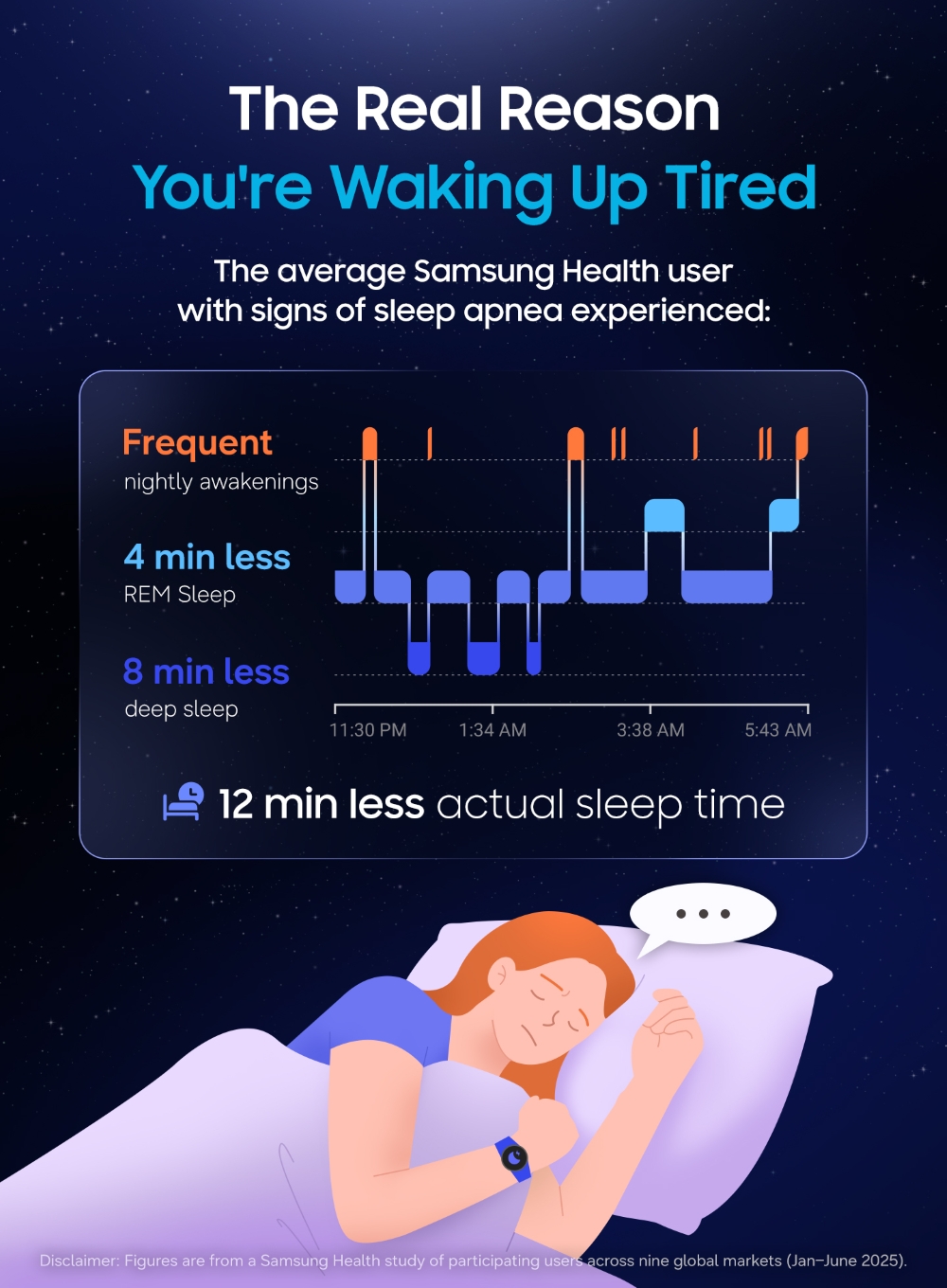
How Does Sleep Apnea Impact Sleep?
The report found that 23% of study participants were at risk of sleep apnea.
“The microarousals and awakenings that follow breathing pauses fragment your sleep,” said behavioral sleep scientist Dr. Vanessa Hill. “Those occurrences can prevent the brain from staying in the rapid eye movement (REM) and deep sleep stages necessary for cognitive and physical restoration.”
The report showed these constant disruptions take a direct toll on sleep duration and quality, leading to:
- Reduced REM Sleep: Participants with moderate to severe sleep apnea indicators detected by Galaxy Watch got around four minutes less REM sleep, the phase where the brain processes emotions, consolidates memories and cements learning. Without enough of it, people can experience mood instability and memory problems, impacting performance at work and overall well-being.
- Less Deep Sleep: Sleep apnea also robs sufferers of deep sleep — approximately eight minutes less per night on average. This is the body’s critical physical restoration phase, where growth hormone is released, muscles are repaired and the immune system is activated. Losing deep sleep may leave people feeling physically exhausted, experiencing slower recovery times and getting sick more often.
- Frequent Nightly Awakenings: Participants with signs of sleep apnea also woke up more regularly during the night and stayed awake around four minutes longer. These interruptions derail the sleep cycle, locking people into lighter, less restorative stages and making next-day exhaustion inevitable, no matter how long they slept.
- Shorter Sleep Duration: Overall, people with a higher likelihood of sleep apnea averaged around 12 minutes less sleep. While this loss may seem minor, it can significantly impact sleep quality as sleep cycles become fragmented throughout the night.
Why It Matters: “Even a small loss in sleep duration is compounded by a larger loss of sleep quality,” said Dr. Hill. “This can be the difference between simply being ‘in bed’ and getting restorative rest, which could be why people feel so tired the next day.”
Dr. Hill also advocates a multidimensional approach to sleep health. “Sleep apnea affects many dimensions of sleep — duration, quality, sleep efficiency and even daytime fatigue,” she added. “Together, they help determine our health and functioning.”
With sleep apnea shown to impact multiple aspects of sleep and lead to other health complications, detection is an essential first step in the fight against the condition.
How Does Galaxy Watch Help Detect Signs of Moderate to Severe Sleep Apnea?
For years, sleep apnea has been difficult to detect due to the need for inconvenient hospital tests. However, Samsung offers at-home detection with a first-of-its-kind Sleep Apnea[3] feature on Galaxy Watch.
- How It Works: Users simply track their sleep with a compatible Galaxy Watch[4] for more than four hours on two nights within a ten-day period. Available through the Samsung Health Monitor app, the Sleep Apnea feature enables users to proactively spot signs of the condition. Initially launched in Korea, the feature has since received De Novo authorization from the U.S. Food and Drug Administration (FDA) and is now available in 78 markets[5] worldwide and counting.
- The Technology: Leveraging Galaxy Watch’s BioActive Sensor, the feature tracks blood oxygen levels to determine when the user stops breathing (apnea) or experiences shallow breathing (hypopnea). Based on this data, the feature estimates the user’s Apnea-Hypopnea Index (AHI), which indicates the severity of obstructive sleep apnea (OSA).
- From Awareness to Action: By detecting signs of sleep apnea early, the feature provides the data needed for an informed consultation with a medical professional. In addition to tackling sleep apnea, Galaxy Watch can help users build habits for better holistic sleep health. Features include the Sleep Coaching program for detailed analysis and tips on how to improve sleep quality and Bedtime Guidance,[6] which recommends optimal bedtimes to ensure consistent sleep.
“For years, the inconvenience of an in-lab clinical sleep study has been a barrier to diagnosing sleep apnea,” said Dr. Hill. “Wearable technology such as Galaxy Watch is a breakthrough because it democratizes that first step, allowing people to gather meaningful data from their own beds and providing a starting point for a conversation with a healthcare professional.”
Take Control of the Night
A good night’s sleep is the first step toward a healthier, more energized life, and Samsung is here to help guide users. Samsung’s ecosystem offers end-to-end care, from detecting signs of sleep apnea on Galaxy Watch to providing suggestions to seek professional adviceto connecting you with professional advice through our health network.
Looking ahead, Samsung is constantly innovating and improving the Sleep Apnea feature to make it even more powerful with sharper insights. Prioritizing rest today can help unlock a healthier tomorrow.
[1] “Obstructive Sleep Apnea National Indicator Report,” American Academy of Sleep Medicine (2023)
[2] Samsung Health users from the U.S., Korea, Brazil, Canada, Mexico, Russia, Chile, South Africa and the Philippines participated in the study from January to June 2025.
[3] The Sleep Apnea feature is an over-the-counter (OTC), software-only, mobile medical application operating on a compatible Samsung Galaxy Watch and Galaxy smartphone. It is intended for on-demand use. Users should not use this feature to replace traditional methods of diagnosis and treatment by a qualified clinician. The data provided by this device is also not intended to assist clinicians in diagnosing sleep disorders. For users over the age of 22 who have not been diagnosed with sleep apnea, the feature monitors for signs of moderate to severe obstructive sleep apnea (OSA).
[4] Availability may vary by market, carrier, model or paired smartphone. Available on the Galaxy Watch4 series and later models. The Galaxy Watch requires the Wear OS 5.0 version or later and must be paired with a Samsung Galaxy smartphone with Android 12.0 or later.
[5] Supported markets include Australia, Austria, Azerbaijan, Bahrain, Belgium, Bolivia, Brazil, Bulgaria, Canada, Chile, Christmas Island, Cocos (Keeling) Islands, Croatia, Cyprus, Czech Republic, Denmark, Dominican Republic, Ecuador, Egypt, El Salvador, Estonia, Faroe Islands, Finland, France, Georgia, Germany, Greece, Guatemala, Hong Kong, Hungary, Iceland, Iraq, Ireland, Israel, Italy, Jordan, Korea, Kuwait, Latvia, Lebanon, Lithuania, Luxembourg, Malaysia, Mauritius, Mayotte, Mexico, Netherlands, Nicaragua, Norfolk Island, Norway, Oman, Panama, Paraguay, Peru, Philippines, Poland, Portugal, Qatar, Romania, Russia, Réunion, Slovakia, Slovenia, South Africa, Singapore, Spain, Sri Lanka, Sweden, Switzerland, Syria, Taiwan, Thailand, United Arab Emirates, United Kingdom, United States, Venezuela, Vietnam and Yemen.
[6] Bedtime Guidance is available on Android phone (Android 11 and above) and requires the Samsung Health app (v6.30.2 or later). Bedtime Guidance is based on three days of sleep analysis of the user’s circadian rhythm and sleep pressure. Intended for general wellness and fitness purposes only. The measurements are for personal reference only. Not intended for use in the detection, diagnosis or treatment of any medical condition or sleep disorder. Please consult a medical professional for advice.


