[World Heart Day] Check your heart rate every day, starting from your wrist


No matter who you are or what you do, we all have one constant companion we rely on every single day: our heart. Unseen but always at work, it beats around 100,000 times a day, keeping pace with us through every moment. Yet for something so essential to our lives, taking care of our hearts is often overlooked until it’s too late.
Heart disease is the number one cause of death worldwide,[1] which is why the World Health Organisation (WHO) and the World Heart Federation recognise 29 Sept as World Heart Day. It is a reminder that the choices we make today can make a meaningful difference tomorrow.
These choices don’t have to be big. From choosing when to go to bed to making time for even just 30 minutes of exercise, the small choices we make every day add up to a healthier lifestyle. The good news is that an help you make proactive prevention part of daily life. By monitoring your sleep, activity level, stress and blood pressure, Galaxy Watch [2] helps you better understand what’s happening in your body and what steps to take to support your heart is doing its job well.[3]
Understanding Your Body at a Glance: Heart Health Score
The American Heart Association recommends looking at Life’s Essential 8[4] as key measures for improving and maintaining cardiovascular health: diet, exercise, sleep, weight, blood pressure, blood sugar, cholesterol and smoking cessation. But knowing what matters raises an important question: how do these factors change the choices we make every day?
Samsung Health’s Heart Health Score[5] is designed to help you in this journey. It tracks and analyses health indicators such as sleep duration, daily activity level, body composition and vascular load,[6] converting them into a single, simple score that anyone can intuitively understand and follow.
Think about what happens if you miss your daily exercise for a few days: your Galaxy Watch recognises your moderate-to-high intensity activity level has decreased, reflects this change in a lower Heart Health Score, and makes a recommendation to go for a run. With convenient insights right from your wrist, Galaxy Watch delivers personalised insights that make it easier to recognise changes, understand your habits, and take the next step toward healthier ones.
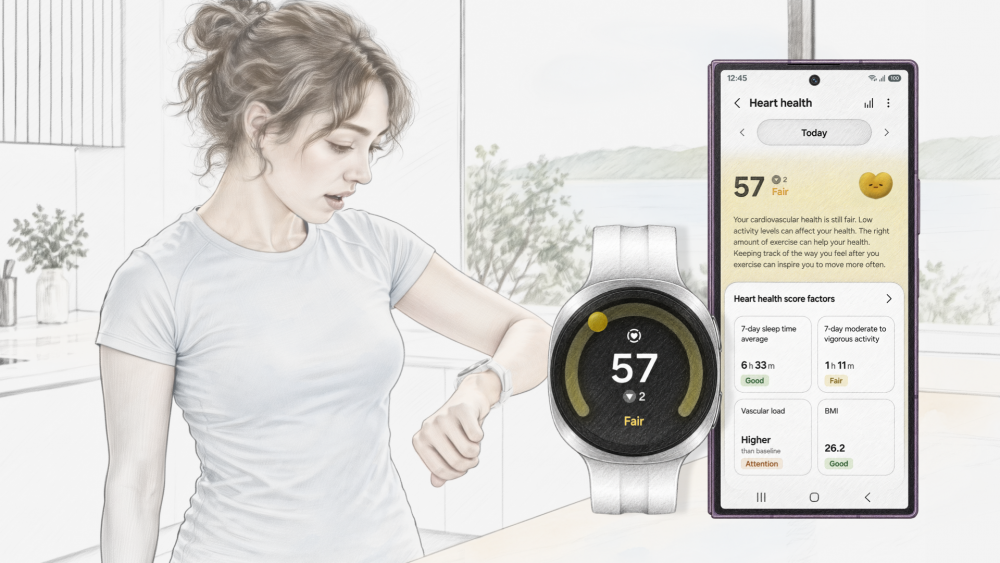
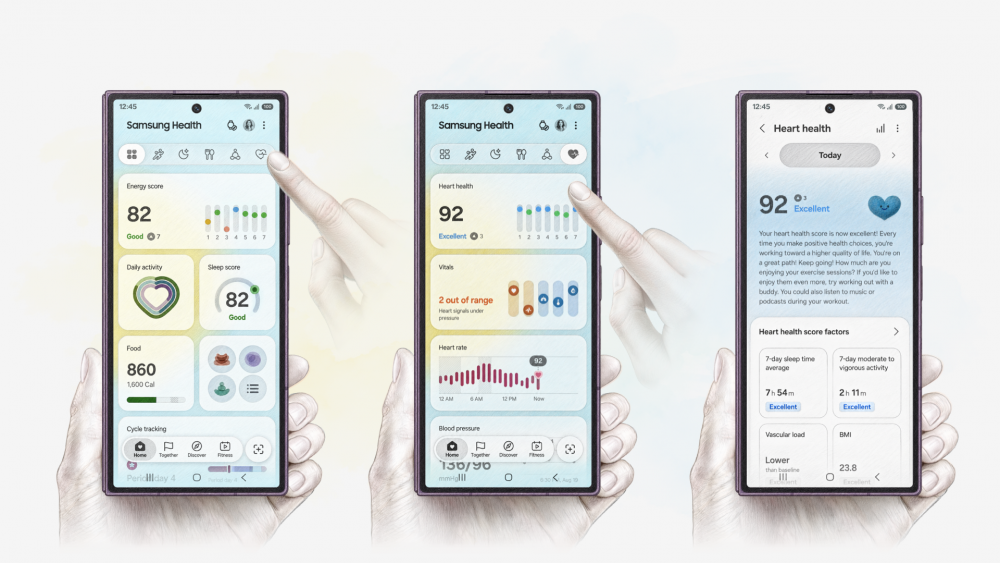
Galaxy Watch and Samsung Health provide effortless understanding of cardiovascular wellness through the Heart Health Score. Image simulated for illustrative purposes. Actual UX/UI may be different.
Advanced Sensor Technology: From Measurement to Meaning
Samsung Galaxy Watches are equipped with an advanced which integrates three precision sensors in one: an optical heart rate sensor (PPG), an electrocardiogram sensor (ECG),[7] and a bioelectrical impedance analysis sensor (BIA).
With calibration just once every four weeks using a home blood pressure monitor, you can easily check your blood pressure[8] from your wrist anytime, anywhere. When you place your finger on the watch’s side electrode for just 30 seconds, the watch measures an electrocardiogram to detect potential signs of abnormal heartbeats. The Irregular Heart Rhythm Notification (IHRN)[9] feature, which detects potential abnormal heart signals, monitors the user’s heart rhythm throughout the day and provides a proactive notification if abnormal signs are repeated.
Even small reminders like this can make a meaningful difference to heart health awareness. In several countries, these notifications[10] have led to early awareness of risks such as certain cardiovascular concerns.
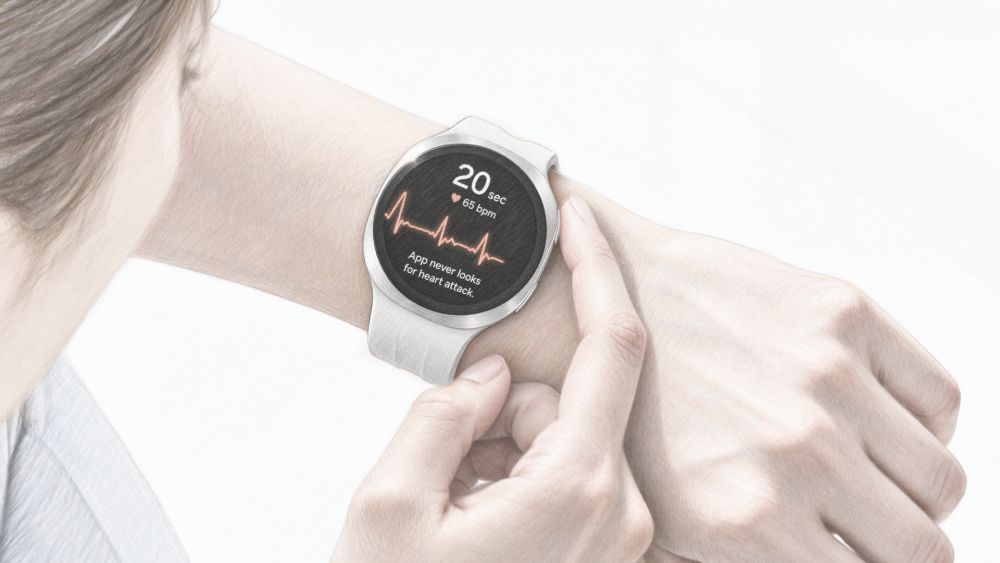
Galaxy Watch supports heart rhythm monitoring through irregular heart rhythm notifications and ECG readings. Image simulated for illustrative purposes. Actual UX/UI may be different.
Around-the-Clock Care: How Galaxy Watch Proactively Monitors Your Health Even During Sleep
Your heart is a constant you can count on, and it works whether you’re awake or asleep. When you wear your Galaxy Watch to sleep, it analyses: heart rate during sleep, heart rate variability,[11] respiratory rate, skin temperature and blood oxygen saturation.[12] These signals are compared against your personal baseline.
When you wake up, your Galaxy Watch will send a notification if it detects deviations from your baseline. By highlighting meaningful changes early, it gives you an opportunity to rest, recover or seek medical guidance before small issues become larger concerns.[13]
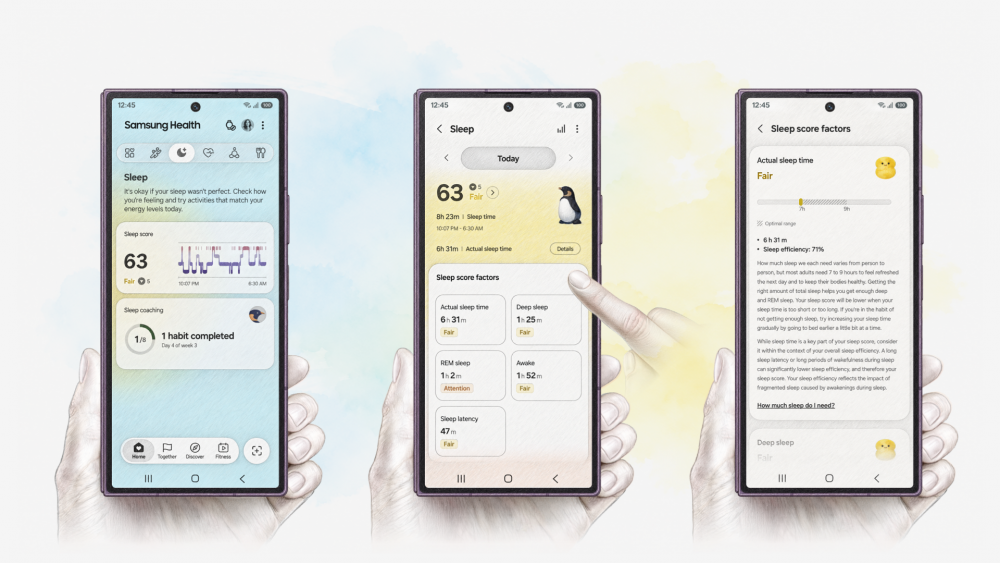
Galaxy Watch and Samsung Health give users a clear view of their sleep quality with detailed metrics and insights they can use to improve their sleep habits.
Heart to Heart: Connected Care That Adds Peace of Mind
Looking after your own heart is only one side of the story. From parents to partners, siblings to grandparents or even friends, the burden of caring for the hearts of those around you weighs heavily. Samsung Health’s Health Data Sharing[14] function lightens the load by sharing agreed-upon data items (number of steps, blood pressure, heart rate, medication adherence, etc.) with loved ones in real time.
You can check if your parents who live far away have completed their daily walk or taken their prescribed medication on time, just as if you were right there with them.
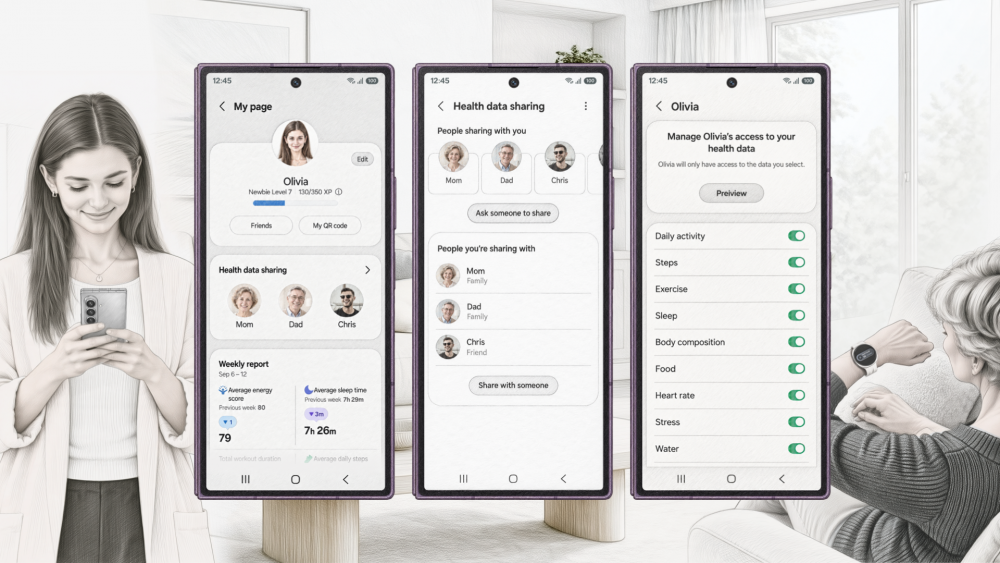
Samsung Health lets users share selected health data with loved ones, helping them stay connected and informed about one another’s wellbeing. Image simulated for illustrative purposes. Actual UX/UI may be different.
World Heart Day coincides with the seasonal transition when chilly winds begin to blow in the mornings and evenings.
The key to preventing heart disease lies not in reactive treatment, but in proactive habits of paying close attention to the subtle signals your body sends every day. Start managing your heart health with Galaxy Watch, a reliable health partner that stays with you around the clock.
For more information about Samsung Galaxy Watches, please visit samsung.com/au/watches/
[1] Source: World Health Organization (WHO), “Cardiovascular diseases (CVDs)” Fact Sheet (July 31, 2025), “The top 10 causes of death” (Aug. 7, 2024).
[2] Health features referred to in this article are only available on newer models of the Galaxy Watch9 and Galaxy Watch Ultra2. Some health features may be available for older models of the Galaxy Watches via a software update later in the year.
[3] Galaxy Watch is not intended for use in the diagnosis or treatment of any medical condition. If you have health concerns, be sure to see a medical professional. Vitals requires sleep data of at least 7 nights. Vitals is available on Android phones (Android 11 or above) and requires the Samsung Health app (v7.0 or above). Samsung account login required. To use Vitals, it is necessary to wear a Galaxy Watch or Galaxy Ring while sleeping.
[4] Source: American Heart Association (AHA), “Life’s Essential 8” (2022).
[5] Heart health is available on Android phones (Android 13 or above) and requires Samsung Health app (v7.0 or above). Samsung Account login required. Requires initial setup wearing watch for 24 hours (including awake and asleep). To calculate Heart health score, data on related lifestyle factors – including sleep duration, BMI, vascular trends and stress, and moderate to vigorous activity time – must be collected. To use this feature, you need a Galaxy Watch7 or above with One UI 9 or above. Heart health score is not a medical/therapeutic feature. It is solely intended for fitness and wellness purposes only and is not intended for use in the diagnosis of disease or other conditions; or in the cure, mitigation, treatment or prevention of disease; or for the prevention or control of conception or pregnancy. Samsung recommends that you consult with your doctor or physician before participating in any exercise program.
[6] Vascular Load feature available on Android phones (Android 10 or above) and requires the Samsung Health app (v6.30.2 or above). Samsung account login required. It is required to wear Galaxy Watch (Galaxy Watch Ultra, Watch8 and later released Galaxy Watch series) when sleeping for at least 3 days out of recent 14 days. Vascular load feature does not act as a medical/therapeutic device. It is solely intended for fitness and wellness purposes only and is not intended for use in the diagnosis of disease or other conditions; or in the cure, mitigation, treatment or prevention of disease; or for the prevention or control of conception or pregnancy. Samsung recommends that you consult with your doctor or physician before participating in any exercise program.”
[7] “The ECG feature is intended to create, record, store, transfer, and display a single channel electrocardiogram (ECG), similar to a Lead I ECG for adults 22 years and older. The ECG feature is not intended to replace traditional methods of diagnosis or treatment. The ECG feature is not intended for users with other known arrhythmias. If an irregular heartbeat or atrial fibrillation is detected, consult a doctor. If you experience symptoms of a heart attack, stroke, or other cardiovascular conditions, do not rely on the notification of the device and consult a doctor. FOLLOW THE INSTRUCTIONS FOR USE. IF SYMPTOMS PERSIST, WORSEN OR CHANGE UNEXPECTEDLY, TALK TO YOUR HEALTH PROFESSIONAL.”
[8] Blood pressure feature only to be used by adults 22 years and older. Intended for general wellness and fitness purposes only. Not intended for use in detection, monitoring, diagnosis, treatment of any medical condition or disease. The measurements are for your personal reference only. Please consult a medical professional for advice. For accurate BP readings, a calibration is required every 28 days by BP monitor & arm cuff. Requires a Galaxy smartphone running Android 7.0 or above. Users should measure their blood pressure when at rest, as they would do with a traditional cuff, and refrain from measuring when they are working out, smoking or drinking. Measured blood pressure history can be reviewed within the Samsung Health Monitor app on a paired smartphone.”
[9] The ECG Monitor App is intended for adults 22 years and older analyses pulse rate data to identify episodes of irregular heart rhythms suggestive of atrial fibrillation (AFib) and provides a notification suggesting the user record an ECG to analyze the heart rhythm. The IHRN feature is not intended to provide a notification on every episode of irregular rhythm suggestive of AFib and the absence of a notification is not intended to indicate no disease process is present. The ECG Monitor App is not intended to replace traditional methods of diagnosis or treatment. The ECG Monitor App is not intended for users with known arrhythmias other than AFib or users under 22 years old. Users should not interpret or take clinical action based on the device output without consultation of a qualified healthcare professional. If an irregular heartbeat or atrial fibrillation is detected, consult a doctor. If you experience symptoms of a heart attack, stroke, or other cardiovascular conditions, do not rely on the notification of the device and consult a doctor. ALWAYS FOLLOW THE INSTRUCTIONS FOR USE. IF SYMPTOMS PERSIST, WORSEN OR CHANGE UNEXPECTEDLY, TALK TO A HEALTHCARE PROFESSIONAL.
[10] Source: “When Every Second Counts: Galaxy Watch Series Health Features Help Save Lives,” Samsung Newsroom
[11] Heart Rate Variability (HRV) feature analyzes minute-to-minute variations in the intervals between heartbeats to show autonomic nervous system balance. It is automatically recorded during sleep and resting states.
[12] Vitals is available on Samsung Galaxy phones and requires Samsung Health app. Samsung Account login required. Requires initial setup wearing the Galaxy Watch for 7 out of 28 nights. Vitals is not a medical/therapeutic feature. It is solely intended for fitness and wellness purposes only and is not intended for use in the diagnosis of disease or other conditions; or in the cure, mitigation, treatment or prevention of disease; or for the prevention or control of conception or pregnancy. Samsung recommends that you consult with your doctor or physician before participating in any exercise program.
[13] Heart Health Score and Vitals features are supported on the Samsung Health app (version 7.0 or higher).
[14] Health Data Sharing feature requires user consent, and users can independently choose which health data to share (including steps, workouts, sleep, weight, body composition, food intake, heart rate, stress, blood pressure, blood glucose, medication and vital signs).
Products > Mobile & wearables
For any issues related to customer service, please go to Samsung.com/au/support for assistance.
For media inquiries, please contact mediateam@samsung.com.


