Two Delhi Students Develop Voice-First AI Companion for Visually Impaired Learners
12-10-2026
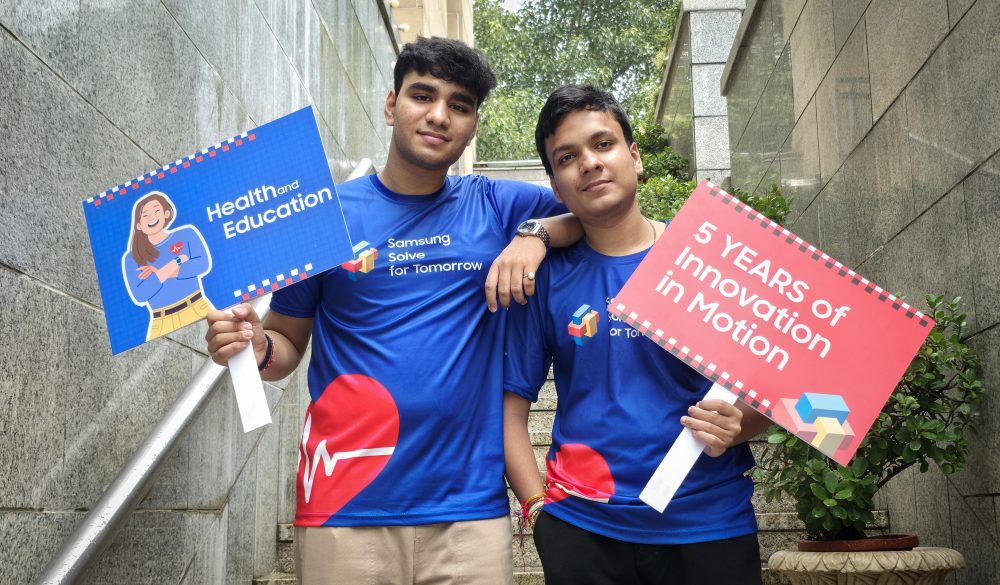
As artificial intelligence begins to reshape classrooms, learning is becoming increasingly interactive, digital and personalised. But for visually impaired students, accessing these new possibilities can present a different set of challenges. As educational tools evolve, how can students who cannot rely on screens navigate this changing landscape and participate more independently in their learning?
For Aditya and Sparsh, two 17-year-olds from Delhi, this is a question worth working on.
Together, they have built Team Equinox and are developing SARA AI, a voice-first, agentic AI companion designed to make digital learning more accessible to visually impaired students. Their idea is now among the Top 20 solutions submitted for Samsung Solve for Tomorrow 2026.
A global problem-solving platform, Samsung Solve for Tomorrow helps youth around the world use STEM (science, technology, engineering, and math) to build a better future. Participants identify problems in their communities and develop creative solutions with the help of technology.
The idea is rooted in a simple ambition: as technology changes how students learn, access to those opportunities should not depend on whether someone can see a screen.
SARA AI is being developed to let students interact with learning through voice commands, convert speech into text, track their learning progress and participate in tests and assessments. It can also check in with users after periods of inactivity, helping create a more interactive learning experience.
For the two young innovators, the challenge goes beyond building a piece of technology. It is about exploring how AI can support students in navigating their education with greater independence and confidence.
Building for the learner, not just the technology
Ideas often begin with a problem, but making them useful requires listening to the people who experience it. Team Equinox has tested SARA AI with more than 40 students in Delhi and engaged with schools and trusts to better understand the needs of visually impaired learners.
These interactions have helped the team explore how the solution might work in real learning environments, where accessibility, ease of use and reliability matter as much as the technology itself.
The experience has also highlighted an important lesson for the young innovators: a promising prototype is only the beginning. For a solution to make a difference, it must respond to everyday needs and work for the people it is intended to serve.
Team Equinox is among the Top 20 teams selected for Samsung Solve for Tomorrow (SFT), a global problem-solving platform that encourages young people to use science, technology, engineering and mathematics (STEM) to address challenges in their communities.
Through the programme, the team is receiving guidance to take SARA AI beyond its initial prototype and explore how it could become a practical, scalable solution for visually impaired students.
From a working prototype to a real-world solution
The SFT Bootcamp gave Aditya and Sparsh an opportunity to look at their idea from perspectives beyond technology. Sessions on design thinking, marketing and the startup ecosystem encouraged them to consider not just how SARA AI functions, but also how students might use it, how its reliability could be improved and what it would take to introduce it into educational settings.
Mentorship helped the team refine its prototype, while one-on-one sessions with Samsung and FITT, IIT Delhi, along with inputs from AI experts in Samsung’s R&D ecosystem, helped them work through technical challenges and explore a potential go-to-market strategy.
For two 17-year-olds navigating the journey from an idea to a potential real-world solution, this exposure has broadened the scope of what building technology entails. It has brought questions of usability, implementation and adoption into sharper focus.
The team is now exploring how SARA AI could be adopted by schools, non-governmental organisations and other institutions that support visually impaired students.
A bigger classroom for the idea
Team Equinox hopes to expand SARA AI across schools in Delhi, with the potential to reach approximately 6,000 students, subject to further development and adoption.
The ambition is significant, but the idea begins with an everyday need: making learning easier to access for students who may otherwise face barriers when educational experiences are designed primarily around visual interfaces.
For Aditya and Sparsh, the journey through Samsung Solve for Tomorrow is an opportunity to understand what it takes to turn that ambition into something practical. Their experience reflects a larger lesson about innovation: meaningful solutions are shaped not only by technical possibilities, but also by the willingness to listen, learn and keep improving.
As AI becomes a more prominent part of education, Team Equinox is working towards a future in which visually impaired students can engage with these tools on more inclusive terms.
At 17, the two Delhi students are still developing their idea. But with SARA AI, they are asking a question that matters far beyond their own classroom: as technology moves learning forward, how can we make sure everyone has a chance to move forward with it?


