At Samsung Innovation Campus, I Didn’t Just Learn to Code. I Learned to Believe that I Belonged in Technology
08-09-2026
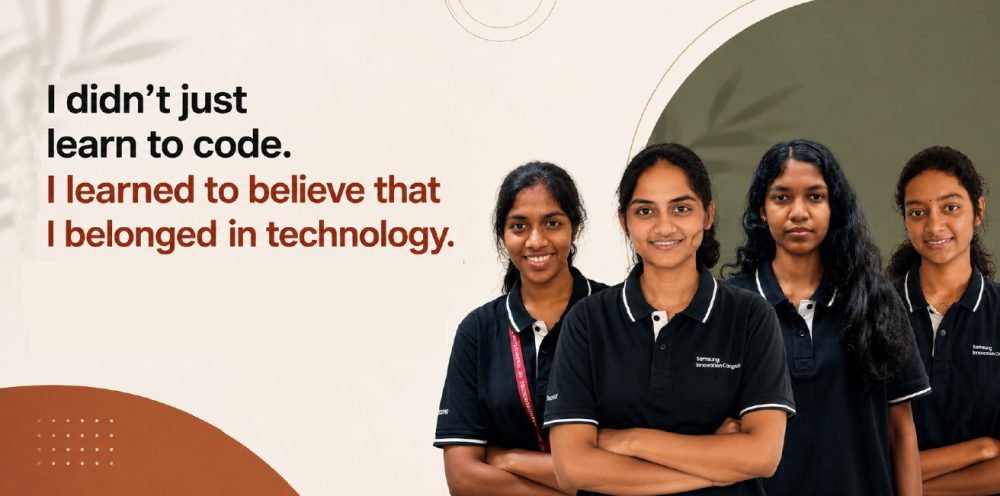
It is a simple sentence, but one that captures what Samsung Innovation Campus (SIC) hopes every student takes away from the programme.
Across classrooms in South India, young engineering students are learning Artificial Intelligence, Internet of Things (IoT) and Coding & Programming through Samsung Innovation Campus, Samsung’s flagship CSR initiative. They arrive looking for technical skills and leave with something far more valuable like confidence, curiosity and a renewed belief in their own potential.
For many, the transformation begins quietly.
Dhanya, a Computer Science student specialising in Artificial Intelligence and Machine Learning, remembers walking into her first Coding & Programming class feeling excited but unsure of herself. Like many students, she had completed coursework before, but translating theory into practical problem-solving seemed intimidating.
Over the next few weeks, that changed.
The structured curriculum, industry-grade labs and hands-on assignments made complex concepts feel approachable. More importantly, the encouragement she received from her mentor changed the way she viewed her own abilities.

That confidence extended well beyond the classroom. Today, Dhanya mentors junior students at her college, a role she never imagined taking on before joining Samsung Innovation Campus.
Her story is one of the many student lives who have benefitted from SIC.
For Maddula Varshini from RNS Institute of Technology, engineering had gradually become an exercise in memorising diagrams and preparing for examinations. The excitement that first drew her towards technology had faded.
Samsung Innovation Campus helped bring it back.
Working with sensors, microcontrollers and cloud platforms, she experienced the thrill of building something that worked outside a textbook. The defining moment came when her team’s IoT prototype successfully transmitted live data to the cloud.

Instead of simply providing answers, trainers encouraged students to troubleshoot, ask questions and think through problems independently. Those experiences helped students develop not only technical competence but also the confidence to solve unfamiliar challenges.
That confidence has opened new doors for students like Meghana.

Coming from a modest background, she often felt that opportunities in technology were reserved for students with better access to resources and guidance. Samsung Innovation Campus challenged that belief.
The practical learning environment helped her develop programming skills while giving her the confidence to ask questions without fear of being judged. Since completing the programme, she has made her first open-source contributions and secured her first internship opportunity.

Sanjana, who enrolled in the Artificial Intelligence course, admits AI initially felt overwhelming.
Through project-based learning, she gradually built machine learning models and eventually developed an emotion detection application as part of her capstone project.
The project represented more than technical progress.
It was proof that she could build solutions capable of addressing real-world challenges. Today, she is preparing for advanced certifications in Data Science and participating in AI hackathons, confident that technology is where she belongs.
While every student’s journey is different, the underlying transformation remains remarkably similar.
“Technology education should do more than teach technical concepts, it should empower young people to believe in their own potential. Through Samsung Innovation Campus, we want students to experience the excitement of creating, solving problems and innovating. When we see students mentoring others, securing internships, participating in hackathons or simply becoming more confident learners, we know the programme is making a meaningful difference,” said Amit Mannan, VP, Software R&D (E).
He believes the programme plays an important role in strengthening India’s innovation ecosystem by complementing academic learning with industry-relevant skills.
“Our goal is not only to prepare students for future careers but to nurture a generation of innovators who will help solve real-world challenges using technology.”
As India continues its rapid digital transformation, initiatives like Samsung Innovation Campus are helping bridge the gap between classrooms and careers.
For students like Dhanya, Varshini, Meghana and Sanjana, the programme may have started with coding exercises, AI models or IoT projects. But what they truly gained was something much harder to teach, and perhaps even more valuable. The confidence to imagine a future they once thought was beyond their reach.


