From Odisha’s Sundargarh to the National Stage: How Two Students Are Using AI to Discover India’s Promising Para-Athletes
07-10-2026
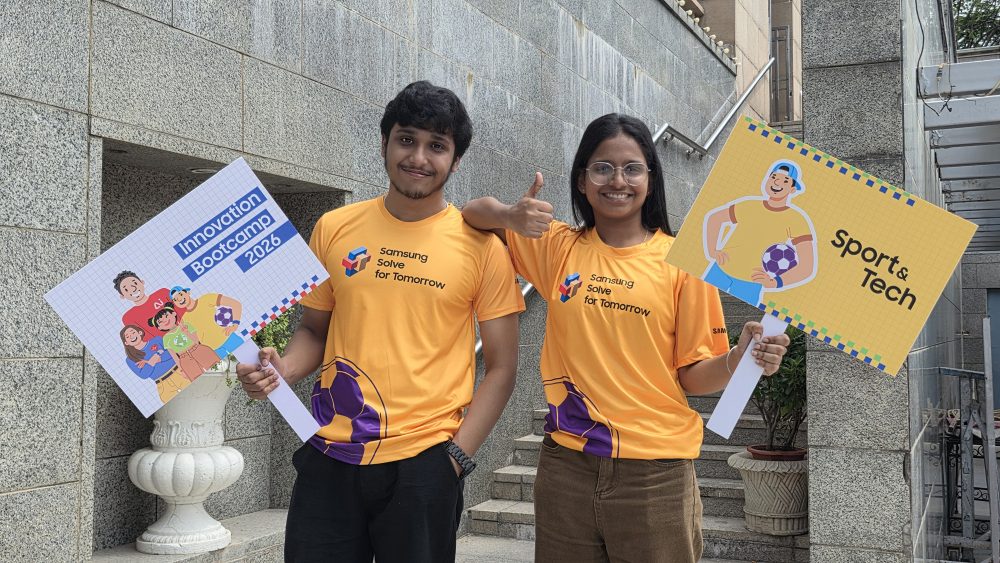
For Team Code Blooded’s 21-year-old Vatala Harika and 20-year-old Ritesh Routray, the idea began with a simple observation: talent can exist anywhere, but opportunity does not always reach everywhere.
Students from the same college in Sundargarh, Odisha, and friends long before they became co-founders, Harika and Ritesh began discussing the challenges faced by para-athletes during a trip. What stood out to them was the absence of accessible scouting infrastructure for talented athletes in Tier-2 and Tier-3 cities and rural areas.
Their idea, ParaSync, is now among the Top 20 innovations at Samsung Solve for Tomorrow 2026. The AI-powered platform is designed to help discover and support para-athletes by allowing them to record or upload a 10–20-minute video of their sporting performance through a smartphone. Its computer vision system analyses sporting technique and physical mechanics, while the platform aims to connect promising athletes with national-level talent scouts.
A global problem-solving platform, Samsung Solve for Tomorrow helps youth around the world use STEM (science, technology, engineering, and math) to build a better future. Participants identify problems in their communities and develop creative solutions with the help of technology.
The solution also envisages tailored warm-up routines, automated progress tracking and secure records that could support medical screening and athlete development.
For Harika and Ritesh, the challenge goes beyond simply identifying sporting talent. Para-athletes are not a homogenous group, they point out, with different athletes requiring different forms of adaptation, coaching and support based on their individual needs.
“We wanted to solve the exact problem we were seeing, and we knew we wanted to use AI to do it,” said Vatala Harika. “There is nothing for para-athletes and their recruitment. Para-athletes are a niche market, but they are not a singular group. There are different models that need to be built for individuals based on the challenges they face.”
The experience at Samsung Solve for Tomorrow helped the team look beyond the technology itself. When they entered the programme, their focus was primarily on solving the problem. The Bootcamp encouraged them to think about whether the solution could work at scale, who would use it, and how it could become a sustainable proposition.
“We were only thinking about solving the problem. But the Bootcamp made us realise that it should solve the problem at a much larger scale,” said Ritesh Routray. “We understood revenue models and got a much clearer sense of the market size. We are techies, so learning to look at the idea from a market perspective helped us understand how we could take ParaSync forward.”
For the students, mentorship became an equally important part of the journey. Harika says the mentors challenged them to look at the problem from different perspectives and, importantly, gave them the confidence to continue pursuing their idea.
“The mentors made me believe in my idea. They made me see the problem from different perspectives. Mentorship helped us understand the problem better,” she said. “Problem-solving depends on how well you understand the problem.”
Their own journey as a team also began organically. Having studied at the same college and being friends, the two were discussing the issue during a trip when the idea for ParaSync began to take shape.
What started as a conversation between two young engineers from Odisha has now evolved into an attempt to build a technology-led pathway between undiscovered para-athletes and the opportunities they need to progress.
For Harika, the journey also reflects a personal evolution. “I always wanted to be in the social space. But then I studied to become an engineer, and now I am using engineering to solve problems,” she said.
As Code Blooded moves forward as one of Samsung Solve for Tomorrow’s Top 20 teams, Harika and Ritesh hope ParaSync can help ensure that where an athlete comes from does not determine whether their talent gets noticed.


