Young Innovators from Amritsar and SAS Nagar Take on Local Challenges in Samsung Solve for Tomorrow Top 40
09-09-2026
Four young innovators from Amritsar and SAS Nagar are developing technology-led solutions to address agricultural residue burning and post-stroke monitoring
More than half of the national Top 40 teams are from Tier 2 and Tier 3 cities, highlighting how India’s next generation of innovators is emerging from across the country
Four winning teams will collectively receive INR 2 crore in grants, along with incubation support from FITT-IIT Delhi
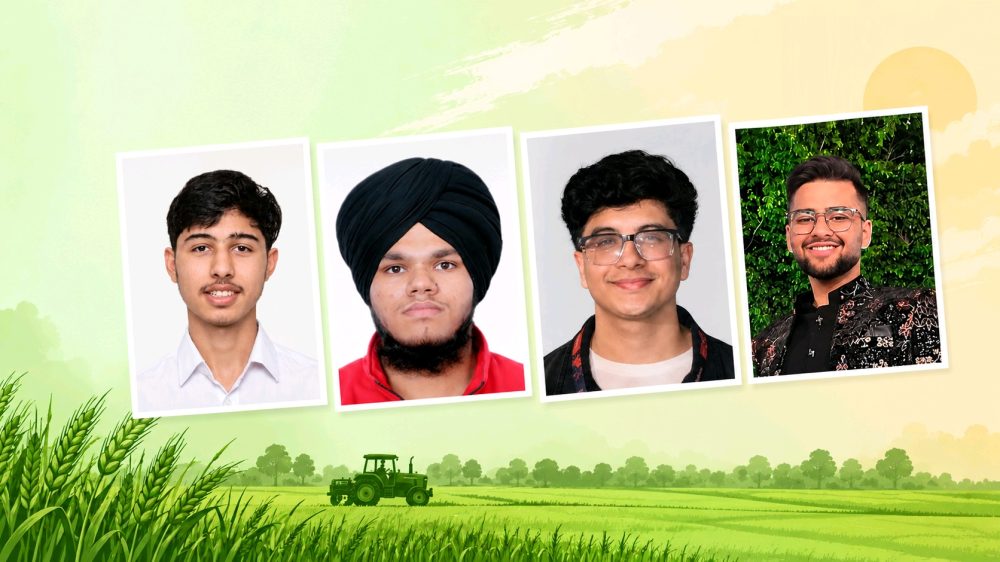
Agricultural residue burning is a prominent challenge in Punjab, particularly during the crop-harvesting season. In Amritsar, 18-year-old Shivansh Sarin is exploring whether agricultural residue could be turned into useful resources instead of being burned. In SAS Nagar, Prabinder Singh, Anish Grover and Deepesh Kakkar are looking at a different challenge — how technology could help families monitor stroke survivors after they return home from the hospital. All four young innovators have made it to the national Top 40 of the fifth edition of Samsung Solve for Tomorrow.
Their ideas are rooted in challenges they see around them, reflecting how young innovators from Punjab are looking at problems in their communities and exploring how technology could help address them.
Samsung Solve for Tomorrow is Samsung’s flagship CSR innovation programme for young people aged 14 to 22. Through design thinking, mentorship and hands-on learning, the programme enables young innovators from across India to identify real-world challenges and develop potential solutions, helping them take their ideas from the early stages towards prototypes.
Two Local Challenges, Four Young Innovators
For 18-year-old Shivansh Sarin from Amritsar, the starting point is a challenge familiar to Punjab’s agricultural landscape: what happens to crop residue after harvesting?
His team, AgriVolt, is exploring how agricultural residue could instead be converted into electricity, biochar and other carbon-rich resources. Building on a school-level prototype that generated electricity from agricultural residue, the proposed solution uses sensor data and reinforcement learning to explore how the process could be optimised while reducing emissions.
For 19-year-olds Prabinder Singh and Anish Grover, and 21-year-old Deepesh Kakkar from SAS Nagar, the challenge begins after a stroke patient leaves the hospital. Their team, NeuroTrace, is developing an AI-powered smartphone solution designed to help families monitor patients at home, when identifying early signs of neurological changes can be difficult.
The solution explores a 45-second daily check-in using voice patterns, facial movement and reaction time to establish an individual neurological baseline and identify sustained changes that could warrant attention.
While the two ideas address very different challenges, both reflect the same starting point for these young innovators: looking closely at a problem in their surroundings and asking whether technology could offer a new way to address it.
Their selection comes as the innovation landscape represented by Samsung Solve for Tomorrow continues to expand. More than half of the national Top 40 teams this year are from Tier 2 and Tier 3 cities, highlighting how young people across India are bringing perspectives shaped by their own communities to real-world challenges.
For Punjab, the presence of young innovators from Amritsar and SAS Nagar among the national Top 40 highlights how innovation is emerging from beyond traditional technology hubs. Their solutions are rooted in distinctly local observations — from the management of agricultural residue in Punjab to the challenges families can face while caring for stroke survivors at home.
Samsung Solve for Tomorrow gives young innovators access to mentorship, technology, design-thinking skills and a platform to take their solutions forward. For Shivansh, Prabinder, Anish and Deepesh, the programme provides an opportunity to test their thinking, strengthen their concepts and move their solutions from early-stage development towards prototyping.
The Top 40 teams will now participate in a 10-day Innovation Bootcamp, where they will receive intensive mentoring from startup founders and industry experts at FITT-IIT Delhi. As part of the Bootcamp, the teams will also get an opportunity to visit Samsung R&D Institute India – Delhi, Samsung R&D Institute India – Noida, Samsung R&D Institute India – Bengaluru, Samsung Design Delhi and Samsung’s Regional Headquarters in Gurugram.
The teams will then compete for a place in the Top 20, which will receive further support to strengthen and advance their solutions ahead of the Grand Finale.
At the culmination of the programme, the four winning teams will collectively receive incubation grants worth INR 2 crore, along with incubation support from FITT-IIT Delhi, helping them take their solutions towards further development and market readiness.


