Samsung Takes Next Stride Toward AI-Native Software-Driven Networks With NVIDIA
Spain on March 1, 2026
Samsung advances AI-RAN capabilities by leveraging NVIDIA accelerated computing at MWC 2026
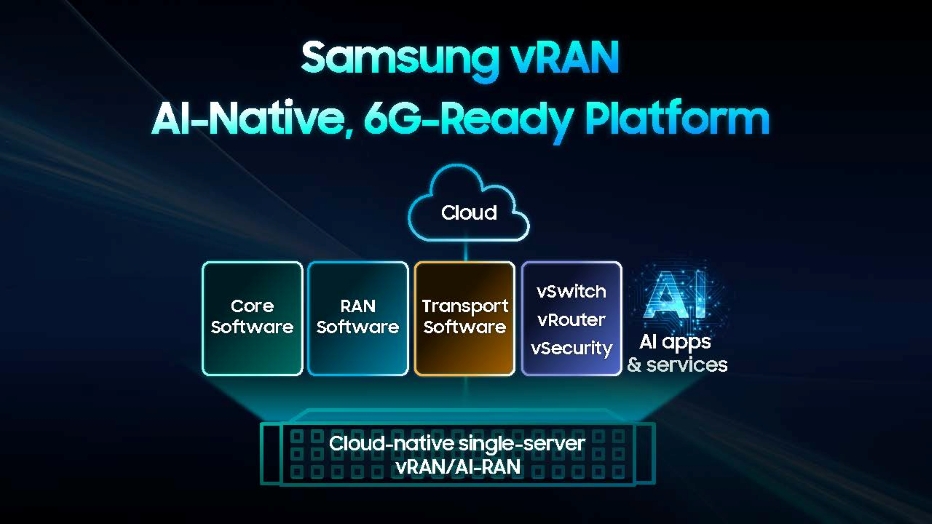
Samsung Electronics today announced the successful completion of a multi-cell test at its R&D center, combining Samsung’s virtualized RAN (vRAN) software with NVIDIA’s accelerated computing platform. The test validates the performance of this integrated solution in a realistic network environment, marking a key step toward commercial deployment.
Samsung will feature this milestone at Mobile World Congress (MWC) 2026 as part of its broader effort to further advance AI enhancements into its market-leading, software-driven network portfolio using NVIDIA platforms. The company will present an AI-RAN demonstration running on NVIDIA AI infrastructure ― an AI-based downlink performance boost (AI MIMO1 beamformer) that leverages AI algorithms for improved throughput. This demonstration will show how AI can deliver higher spectral efficiency for operators, extracting more capacity from existing spectrum. Together, these activities reflect Samsung’s leadership in bringing AI-RAN innovation towards commercialization.
“As AI-powered capabilities become integral to meeting the demands of evolving networks and growing traffic needs, Samsung’s vRAN takes center stage with its software-based architecture,” said Keunchul Hwang, Executive Vice President and Head of Technology Strategy Group, Networks Business at Samsung Electronics. “The successful multi-cell test with NVIDIA is another reinforcement of Samsung’s endeavor and leadership in providing operators with more flexibility and the best performance, with an enriched ecosystem consisting of industry-leading CPU and GPU partners such as NVIDIA.”
The companies are also collaborating on driving innovations to enable high-speed connections between the CPU and GPU, by leveraging Samsung’s vRAN and NVIDIA’s unified processor that embeds CPU and GPU into a single chipset. This allows fast and efficient data exchanges between CPU and GPU while enabling optimal balance of performance and total cost of ownership.
Last month, Samsung and NVIDIA continued toward commercialization by completing the integration of Samsung’s vRAN software and NVIDIA’s ARC Compact equipped with NVIDIA Grace CPU and NVIDIA L4 GPU. Going forward, Samsung is committed to further exploring and verifying the synergies that these solutions bring to advanced networks.
“Operators today need AI-native, software-defined infrastructure to stay ahead of evolving connectivity demands. Samsung’s successful multi-cell validation and innovative AI beamforming solution on NVIDIA AI Aerial mark an important milestone towards AI-RAN commercialization,” said Soma Velayutham, VP of AI and Telecoms, NVIDIA.
By combining its experience from large-scale commercial vRAN deployments and expertise on computing platforms from partners like NVIDIA, Samsung commands the lead in AI-powered, software-based networks.
Samsung Networks has pioneered the successful delivery of 5G end-to-end solutions, including chipsets, radios and cores. Through ongoing research and development, Samsung drives the industry to advance 5G networks with its market-leading product portfolio, from purpose-built RAN, virtualized RAN, Open RAN, AI-RAN, Cloud-native vCore to private network solutions and AI-powered automation tools and applications. The company currently provides innovative network solutions to mobile operators that deliver boundless connectivity to hundreds of millions of users worldwide.
- Multiple-input multiple output, a wireless technology that uses multiple antennas at both the transmitter and receiver to boost data speeds, increase capacity and improve range. ↩︎
For any issues related to customer service, please go to Customer Support pagefor assistance.
For media inquiries, please click Media Contactto move to the form.